Showing posts with label Terrier. Show all posts

Sunday, September 22, 2013

Jack Russell Terrier Rescue and Adoption- Adopt a Jack Russell Terrier Near You

California Los Angeles, San Diego, San Jose, San Francisco, Long Beach,Fresno, Sacramento, Oakland, Santa Ana, Anaheim, Riverside, Bakersfield, Stockton, Fremont, Glendale, Huntington Beach, Modesto,San Bernardino,Chula Vista, Oxnard


Texas Houston, Dallas, San Antonio,Austin,El Paso,Fort Worth, Arlington, Corpus Christi, Plano, Garland, Lubbock, Irving, Laredo, Amarillo, Pasadena,Brownsville, Grand Prairie, Mesquite, Abilene,Beaumont


New York New York City, Buffalo, Rochester, Yonkers, Syracuse, Albany, Cheektowaga, New Rochelle, Mount Vernon, Schenectady, Tonawanda, Utica, Hempstead, Niagara Falls, Brentwood,White Plains, Levittown, Irondequoit, Troy, Binghamton


Florida Jacksonville, Miami, Tampa, St. Petersburg, Hialeah, Orlando, Fort Lauderdale, Tallahassee, Hollywood, Pembroke Pines, Coral Springs, Clearwater, Cape Coral, Gainesville, Port St. Lucie, Miami Beach, Sunrise, Plantation, West Palm Beach,Palm Bay


Illinois Chicago, Rockford, Aurora, Naperville, Peoria, Springfield, Joliet, Elgin, Waukegan, Cicero, Decatur, Arlington Heights, Schaumburg, Evanston, Champaign, Palatine, Bloomington, Skokie, Des Plaines, Bolingbrook


Pennsylvania Philadelphia, Pittsburgh, Allentown, Erie, Reading, Scranton, Bethlehem, Lancaster, Levittown, Altoona, Harrisburg, Penn Hills, Wilkes-Barre, York, State College, Chester, Bethel Park, Mount Lebanon, Ross Township, Norristown


Ohio Columbus, Cleveland, Cincinnati, Toledo, Akron, Dayton, Parma, Youngstown, Canton, Lorain, Springfield, Hamilton, Kettering, Lakewood, Elyria, Euclid, Middletown, Mentor, Cleveland Heights, Cuyahoga Falls


Michigan Detroit, Grand Rapids, Warren, Flint, Sterling Heights, Lansing, Ann Arbor, Livonia, Dearborn, Clinton, Westland, Farmington Hills, Troy, Southfield, Kalamazoo, Canton, Waterford, Wyoming MI, Pontiac MI


Ontario Toronto, Ottawa, Mississauga, Hamilton, Brampton, London Canada, Markham, Vaughan, Windsor, Kitchener


New Jersey Newark, Jersey City, Paterson, Elizabeth NJ, Edison, Toms River, Trenton, Camden, Clifton, East Orange, Passaic, Union City, Bayonne, Irvington, Vineland, Union, Wayne, New Brunswick, Plainfield, Bloomfield


Georgia Atlanta, Augusta-Richmond, Columbus, Savannah, Athens-Clarke, Macon, Sandy Springs, Roswell, Albany, Marietta, Warner Robins, Valdosta, Smyrna, East Point, North Atlanta, Rome, Alpharetta, Redan, Dunwoody, Peachtree City


North Carolina Charlotte, Raleigh, Greensboro, Durham, Winston-Salem, Fayetteville, Cary, High Point, Wilmington, Asheville, Jacksonville NC, Gastonia, Greenville, Concord NC, Rocky Mount, Chapel Hill, Burlington NC, Wilson NC, Goldsboro, Hickory NC


Virginia Virginia Beach, Norfolk, Chesapeake, Richmond, Arlington VA, Newport News, Hampton VA, Alexandria, Portsmouth, Roanoke, Lynchburg, Suffolk, Burke, Reston, Dale City, Annandale, Centreville, Danville VA, Charlottesville, Tuckahoe


Massachusetts Boston, Worcester, Springfield MA, Lowell, Cambridge, Brockton, New Bedford, Fall River, Lynn MA, Quincy, Newton, Somerville, Lawrence MA, Framingham, Waltham, Haverhill, Brookline MA, Malden MA, Taunton, Medford


Indiana Indianapolis, Fort Wayne, Evansville IN, South Bend, Gary, Hammond, Bloomington IN, Muncie, Anderson IN, Terre Haute, Lafayette IN, Elkhart, Mishawaka, Kokomo, Richmond IN, Columbus IN, Lawrence IN, Fishers IN, Carmel IN, New Albany


Quebec Montréal, Québec, Laval, Gatineau, Longueuil, Sherbrooke, Saguenay, Lévis, Trois-Rivières, Terrebonne


Washington Seattle, Spokane, Tacoma, Vancouver WA, Bellevue, Everett, Federal Way, Kent, Yakima, Bellingham, Lakewood WA, Kennewick, Shoreline, Renton, Redmond WA, Kirkland, Olympia, Auburn,Edmonds, Richland


Tennessee Memphis, Nashville-Davidson, Knoxville, Chattanooga, Clarksville, Murfreesboro, Jackson TN, Johnson City TN, Kingsport, Franklin TN, Hendersonville, Bartlett, Germantown TN, Cleveland TN, Columbia TN, Collierville, Oak Ridge TN, Smyrna, Morristown TN, Bristol


Missouri Kansas City, St. Louis, Springfield, Independence, Columbia MO, St. Joseph MO, Lee’s Summit, St. Charles MO, St. Peters MO, Florissant MO, Blue Springs MO, Chesterfield, O’Fallon MO, Joplin, Jefferson City MO, University City MO, Cape Girardeau, Oakville, Wildwood MO, Ballwin MO


Wisconsin Milwaukee, Madison, Green Bay, Kenosha WI, Racine, Appleton WI, Waukesha, Oshkosh, Eau Claire, West Allis, Janesville, La Crosse, Sheboygan, Wauwatosa, Fond du Lac, Brookfield WI, Wausau, New Berlin WI, Beloit WI, Greenfield WI


Maryland Baltimore, Columbia MD, Silver Spring, Dundalk, Wheaton-Glenmont, Ellicott City MD, Germantown MD, Bethesda, Frederick MD, Gaithersburg, Towson MD, Bowie, Aspen Hill MD, Rockville MD, Potomac MD, Catonsville MD, Bel Air South, Essex MD, Glen Burnie, North Bethesda


Arizona Phoenix, Tucson, Mesa, Glendale AZ, Scottsdale, Chandler, Tempe, Gilbert, Peoria AZ, Yuma, Casas Adobes, Catalina Foothills, Flagstaff, Lake Havasu City, Sun City AZ, Sierra Vista, Avondale AZ, Prescott, Bullhead City AZ, Apache Junction


Minnesota Minneapolis,St. Paul, Duluth, Rochester MN, Bloomington MN, Brooklyn Park, Plymouth, Eagan, Coon Rapids, Burnsville MN, St. Cloud, Eden Prairie, Minnetonke, Maple Grove MN, Edina, Woodbury MN, Apple Valley MN, Blaine MN, St. Louis Park, Lakeville MN


Louisiana New Orleans, Baton Rouge, Shreveport, Metairie, Lafayette, Lake Charles, Kenner, Bossier City, Monroe LA, Alexandria LA, Marrero, New Iberia, Houma, Chalmette, Laplace, Slidell, Terrytown LA, Opelousas, Harvey LA, Ruston


Alabama Birmingham, Montgomery AL, Mobile, Huntsville AL, Tuscaloosa, Hoover AL, Dothan, Decatur AL, Auburn, Gadsden, Florence AL, Bessemer, Madison AL, Prichard, Phenix City, Homewood AL, Vestavia Hills, Prattville, Anniston, Opelika


Colorado Denver, Colorado Springs, Aurora CO, Lakewood CO, Fort Collins, Arvada, Pueblo CO, Westminster CO, Boulder, Thornton CO, Greeley, Longmont CO, Highlands Ranch, Loveland, Southglenn, Grand Junction CO, Littleton, Broomfield CO, Wheat Ridge, Englewood CO


Kentucky Lexington-Fayette, Louisville, Owensboro, Bowling Green KY, Covington, Hopkinsville, Frankfort, Henderson, Richmond KY, Jeffersontown KY, Paducah, Pleasure Ridge Park, Florence KY, Valley Station, Elizabethtown, Ashland KY, Radcliff KY, Newburg, Nicholasville KY, Madisonville


South Carolina Columbia SC, Charleston, North Charleston, Greenville SC, Rock Hill, Mount Pleasant SC, Spartanburg, Sumter, Hilton Head Island, Florence SC, Goose Creek, Summerville, Anderson SC, Aiken, Myrtle Beach, Greenwood SC, St. Andrews SC, Wade Hampton, Taylors SC, Easley


Oklahoma Oklahoma City, Tulsa, Norman OK, Lawton, Broken Arrow, Edmond OK, Midwest City, Enid, Moore, Stillwater, Muskogee, Bartlesville, Shawnee, Ponca City, Ardmore, Duncan OK, Del City, Altus, Yukon, Bethany OK


Oregon Portland OR, Eugene, Salem OR, Gresham, Beaverton, Hillsboro OR, Medford OR, Springfield OR, Bend OR, Corvallis, Aloha OR, Tigard, Albany OR, Lake Oswego, Keizer, McMinnville, Oregon City, Grants Pass, Tualatin, West Linn


Connecticut Bridgeport CT, New Haven, Hartford, Stamford, Waterbury, Norwalk, Danbury CT, New Britain, West Hartford, Bristol CT, Meriden, West Haven, Milford CT, Stratford CT, East Hartford, Middletown CT, Shelton CT, Norwich, Torrington, Trumbull


Iowa Des Moines, Cedar Rapids, Davenport, Sioux City, Waterloo, Iowa City, Council Bluffs, Dubuque, Ames IA, West Des Moines, Cedar Falls, Bettendorf, Mason City, Urbandale, Clinton, Ankeny, Burlington IA, Marion IA, Marshalltown IA, Fort Dodge


Mississippi Jackson MS, Gulfport, Biloxi,Hattiesburg, Greenville MS, Meridian MS, Tupelo, Southaven, Vicksburg MS, Pascagoula, Columbus MS, Clinton MS, Pearl, Starkville MS, Olive Branch,Clarksdale MS, Ridgeland MS, Natchez, Greenwood, Laurel MS


Kansas Wichita, Overland Park, Kansas City, Topeka, Olathe, Lawrence KS, Shawnee, Salina, Manhattan KS, Hutchinson KS, Lenexa, Leavenworth, Garden City KS, Leawood, Emporia, Dodge City KS, Prairie Village, Hays KS, Liberal KS, Pittsburg KS


Alberta Calgary, Edmonton, Red Deer, Strathcona, Lethbridge, St. Albert, Medicine Hat, Wood Buffalo, Grande Prairie, Airdrie


Arkansas Little Rock, Fort Smith, North Little Rock, Fayetteville AR, Jonesboro AR, Pine Bluf, Springdale AR, Conway, Rogers, Hot Springs, Jacksonville AR, West Memphis, Texarkana, Russellville, Paragould, Benton, El Dorado AR, Sherwood AR, Bentonville, Van Buren


Utah Salt Lake City, West Valley City, Provo, Sandy, Orem, Ogden, West Jordan, Layton, Taylorsville UT, St. George UT, Logan UT, Bountiful, Murray UT, Kearns, Roy UT, Millcreek UT, South Jordan, Cottonwood Heights, Midvale, Clearfield UT


Nevada Las Vegas, Paradise NV, Reno, Henderson NV, Sunrise Manor, Spring Valley, North Las Vegas, Sparks NV, Carson,Winchester NV, Pahrump, Sun Valley NV, Whitney NV, Elko, Boulder City, Enterprise NV, Gardnerville Ranchos, Spring Creek, Incline Village-Crystal Bay, Mesquite NV


New Mexico Albuquerque, Santa Fe, Las Cruce, Taos, Tucumcari, Rio Rancho, Roswell, South Valley NM, Farmington NM, Alamogord NM, Clovis, Hobbs, Carlsbad, Gallup NM, Las Vegas NM, Deming, Sunland Park, North Valley NM, Los Alamos, Portales, Artesia, Silver City


West Virginia Charleston WV, Huntington WV, Parkersburg, Wheeling, Morgantown, Weirton WV, Fairmont WV, Beckley, Clarksburg WV, Martinsburg, South Charleston WV, Teays Valley, St. Albans,Bluefield, Vienna WV, Cross Lanes, Moundsville, Dunbar, Oak Hill WV, Bridgeport


Nebraska Omaha, Lincoln, Bellevue, Grand Island,, Kearney, Fremont, Hastings, North Platte, Norfolk NE, Columbus NE, Papillion, Scottsbluff, Beatrice, South Sioux City, La Vista, Chalco, Lexington NE, Alliance, Offutt AFB


Idaho Boise City, Nampa, Pocatello, Idaho Falls, Meridian ID, Coeur d’Alene, Twin Falls, Lewiston, Caldwell, Moscow ID, Rexburg, Post Falls ID, Mountain Home, Eagle ID, Garden City ID, Blackfoot, Chubbuck, Burley, Hayden, Mountain Home AFB


Maine Portland ME, Lewiston, Bangor ME, South Portland ME, Auburn ME, Biddeford ME, Augusta, Saco, Westbrook ME, Waterville, Brunswick ME, Sanford, Presque Isle ME, Bath ME, Brewer, Old Orchard Beach, Caribou, Orono, Old Town ME, Winslow


New Hampshire Manchester NH, Nashua, Concord NH, Rochester NH, Dover, Derry NH, Keene NH, Portsmouth NH, Laconia NH, Claremont, Lebanon, Somersworth, Londonderr, Berlin NH, Exeter, Hampton NH, Durham NH, Franklin NH, Milford NH, Hanover NH


Hawaii Honolulu, Hilo, Kailua, Kaneohe, Waipahu, Pearl City, Waimalu, Mililani Town, Kahului, Kihei, Wahiawa, Ewa Beach, Schofield Barracks, Halawa, Makakilo City, Wailuku, Kaneohe Station, Waipio, Nanakuli, Waianae


Rhode Island Providence, Warwick, Cranston, Pawtucket, East Providence, Woonsocket, North Providence, West Warwick, Newport RI, Bristol, Central Falls, Westerly, Barrington, Valley Falls, Newport East, Greenville RI, Wakefield-Peacedale, Cumberland Hill, Tiverton, Kingston


British Columbia Vancouver, Surrey, Burnaby, Richmond, Abbotsford, North Vancouver, Langley, Coquitlam, Kelowna, Saanich


Montana Billings, Missoula, Great Falls, Butte-Silver Bow, Bozeman, Helena, Kalispell, Havre, Anaconda-Deer Lodge, Miles City, Helena Valley Southeast, Helena Valley West Central, Livingston MT, Laurel MT, Evergreen, Lewistown MT, Belgrade, Orchard Homes, Whitefish, Sidney MT


Nova Scotia Cape Breton, Halifax, New Glasgow, Truro


Delaware Wilmington DE, Dover, Newark DE, Pike Creek, Bear DE, Brookside DE, Hockessin, Glasgow DE, Claymont


South Dakota Sioux Falls, Rapid City MD, Aberdeen, Watertown SD, Brookings SD, Mitchell SD, Pierre, Yankton, Huron


Newfoundland and Labrador Conception Bay South, Corner Brook, Gander, Grand Falls-Windsor, Labrador City, Mount Pearl, Paradise, St. John’s


North Dakota Fargo, Bismarck, Grand Forks, Minot, Mandan, Dickinson, Jamestown, West Fargo, Williston, Wahpeton


Alaska Anchorage, Juneau, Fairbanks, College AK, Sitka, Ketchikan, Knik-Fairview, Kenai, Lakes, Kodiak


Manitoba Brandon, Portage la Prairie, Steinbach, Thompson, Winnipeg


Vermont Burlingto VT, Rutland, South Burlington VT, Barre, Bennington, Essex Junction, Brattleboro, Montpelier, St. Albans, Winooski


District of Columbia Washington DC, Capital Hill, Georgetown, Du Point, Cleveland Park


Wyoming Cheyenne, Casper, Laramie, Gillette, Rock Springs, Sheridan, Green River, Evanston WY, Riverton WY, Cody WY


New Brunswick Bathurst, Dieppe, Edmundston, Fredericton, Miramichi, Moncton, Quispamsis, Riverview, Rothesay, Saint John


Saskatchewan Estevan, Moose Jaw, North Battleford, Prince Albert, Regina, Saskatoon, Swift Current, Yorkton


Prince Edward Island Charlottetown, Summerside


Northwest Territories Yellowknife


Yukon Whitehorse

Saturday, September 21, 2013

Helpful Suggestions For Individuals Looking For Boston Terrier Puppies For Sale

By Essie Craft


The Boston Terrier is a dog that is favored among numerous canine enthusiasts. Therefore, it does not come as a surprise to most people when they discover that many dog lovers shop each year for Boston Terrier puppies for sale. Below are a few tips about this dog breed and its unique characteristics:

This kind of canine is one of the few dog breeds with a history originating in the United States. They are a cross between old English Bulldogs and white English terriers and were first bred in America for the purpose of dogfights. However, in most states they are no longer raised for such purposes. These dogs are renowned for their moderate behavior and loyalty to their owners. They also make perfect companions for people of all ages.


Such dogs are unique and lovable. They feature small and compact frames, but they are very sturdy and well proportioned. They typically have a face that is somewhat square. They also have well-positioned ears, and stiff, short tails. They can weigh as much as 25 pounds; however, the average terrier of this kind usually 10-18 pounds. Their fur is generally black and white, although other shades emerge from time to time in some litters.


The Boston terrier, as previously mentioned, is a loyal and friendly dog. This breed also learns quickly, and for this reason it is not difficult to train them to consistently exhibit appropriate behavior. They are affectionate and playful, and thoroughly enjoy being around humans. Their personalities are mild, and this makes them an excellent dog for children.


Dog lovers should understand that terriers of this kind are quite aggressive with other dogs, even though they exhibit mild behavior around people. For this reason, it is important to ensure that any pets one already owns will adapt to the presence of the new pet. If one is unsure about this, and he or she wishes to have more than one dog, it may be best to simply purchase 2 Boston Terriers. This will eliminate worries about harmony between different breeds.


Similar to all breeds, terriers are associate it with certain health problems. These include eye disorders, heart murmurs, deafness, and allergic reactions. They do not adapt well to extreme temperatures, and for this reason they are not ideal outdoor pets. They can live as long as 15 years, and most live past 10 years.


It is essential to give thought to the circumstances in one’s life when acquiring a new dog. Immediately following the birth of a baby, during holidays, and while home remodeling projects are being completed are not good times to bring home a new pet. It is best to choose a time when the owner’s life is not excessively busy or hectic. In this way, he or she can help the dog settle into its new home and devote an appropriate amount of time to its training.


When searching for Boston Terrier puppies for sale, customers should only consider doing business with reliable breeders and avoid puppy mills at all costs. No matter how much money can be saved, dog enthusiasts should never give into the temptation to purchase a new puppy from a disreputable breeder. Regardless of one’s reason for desiring a dog of this type, he for she will almost certainly be happy with the pleasure and fun a Boston Terrier brings to his or her home.


About the Author:


Soft Coated Wheaten Terrier: The Breed

          (AKC Terrier Group)
As its name implies, the Soft Coated Wheaten Terrier is prized for its coat, which is soft, silky, with a gentle wave, and of warm wheaten color. Underneath, however, is a formidable dog that leaves no doubt as to his terrier origins. Square and medium-sized, he is happy, steady, self-confident and alert to his surroundings.

Soft Coated Wheaten Terrier AKC Breed Standards


General Appearance
The Soft Coated Wheaten Terrier is a medium-sized, hardy, well balanced sporting terrier, square in outline. He is distinguished by his soft, silky, gently waving coat of warm wheaten color and his particularly steady disposition. The breed requires moderation both in structure and presentation, and any exaggerations are to be shunned. He should present the overall appearance of an alert and happy animal, graceful, strong and well coordinated.
Size, Proportion, Substance
A dog shall be 18 to 19 inches at the withers, the ideal being 18½. A bitch shall be 17 to 18 inches at the withers, the ideal being 17½. Major Faults–Dogs under 18 inches or over 19 inches; bitches under 17 inches or over 18 inches. Any deviation must be penalized according to the degree of its severity. Square in outline. Hardy, well balanced. Dogs should weigh 35-40 pounds; bitches 30-35 pounds.
Head
Well balanced and in proportion to the body. Rectangular in appearance; moderately long. Powerful with no suggestion of coarseness. Eyes dark reddish brown or brown, medium in size, slightly almond shaped and set fairly wide apart. Eye rims black. Major Fault–Anything approaching a yellow eye. Ears small to medium in size, breaking level with the skull and dropping slightly forward, the inside edge of the ear lying next to the cheek and pointing to the ground rather than to the eye. A hound ear or a high-breaking ear is not typical and should be severely penalized. Skull flat and clean between ears. Cheekbones not prominent. Defined stop. Muzzle powerful and strong, well filled below the eyes. No suggestion of snipiness. Skull and foreface of equal length. Nose black and large for size of dog. Major Fault–Any nose color other than solid black. Lips tight and black. Teeth large, clean and white; scissors or level bite. Major Fault–Undershot or overshot.
Neck, Topline, Body
Neck medium in length, clean and strong, not throaty. Carried proudly, it gradually widens, blending smoothly into the body. Back strong and level. Body compact; relatively short coupled. Chest is deep. Ribs are well sprung but without roundness. Tail is set on high. Docked tail preferred. Whether docked or natural, the tail is to be carried upright 90* from the back, either straight or with a slight curve forward. Any deviation from this ideal is to be penalized accordingly.
Forequarters
Shoulders well laid back, clean and smooth; well knit. Forelegs straight and well boned. All dewclaws should be removed. Feet are round and compact with good depth of pad. Pads black. Nails dark.
Hindquarters
Nutro® Natural Choice® Grain-Free Venison & Potato Dog Food - PetSmartHind legs well developed with well bent stifles turning neither in nor out; hocks well let down and parallel to each other. All dewclaws should be removed. The presence of dewclaws on the hind legs should be penalized. Feet are round and compact with good depth of pad. Pads black. Nails dark.
Coat
A distinguishing characteristic of the breed which sets the dog apart from all other terriers. An abundant single coat covering the entire body, legs and head; coat on the latter falls forward to shade the eyes. Texture soft and silky with a gentle wave. In both puppies and adolescents, the mature wavy coat is generally not yet evident. Major Faults–Woolly or harsh, crisp or cottony, frizzy, kinky or standaway coat; in the adult, a straight coat is also objectionable.
Presentation–For show purposes, the Wheaten is presented to show a terrier outline, but coat must be of sufficient length to flow when the dog is in motion. The coat must never be clipped or plucked. Sharp contrasts or stylizations must be avoided. Head coat should be blended to present a rectangular outline. Eyes should be indicated but never fully exposed. Ears should be relieved of fringe, but not taken down to the leather. Sufficient coat must be left on skull, cheeks, neck and tail to balance the proper length of body coat. Dogs that are overly trimmed shall be severely penalized.
Color
Any shade of wheaten. Upon close examination, occasional red, white or black guard hairs may be found. However, the overall coloring must be clearly wheaten with no evidence of any other color except on ears and muzzle where blue-gray shading is sometimes present. Major Fault–Any color save wheaten. Puppies and Adolescents–Puppies under a year may carry deeper coloring and occasional black tipping. The adolescent, under two years, is often quite light in color, but must never be white or carry gray other than on ears and muzzle. However, by two years of age, the proper wheaten color should be obvious.
Gait
Gait is free, graceful and lively with good reach in front and strong drive behind. Front and rear feet turn neither in nor out. Dogs who fail to keep their tails erect when moving should be severely penalized.
Approved August 10, 2009
Effective September 30, 2009


Soft Wheaten Terrier Health Issues


Soft-coated Wheaten Terriers are generally a long-lived breed. They are susceptible to various heritable diseases, although are most known for two protein wasting conditions: protein-losing nephropathy (PLN), where the dogs lose protein via the kidneys; and protein-losing enteropathy (PLE), where the dogs fail to fully absorb protein in their digestive tracts, causing it to pass in their stool. Both PLN and PLE are potentially fatal, but if caught early enough, can sometimes be managed with strict dietary changes and pharmaceuticals. Laboratory tests can aid in diagnosing PLN and PLE; Wheaten owners should check their country’s advised testing protocols.  These conditions have an unknown mode of inheritance, but research programs, mainly in the United States and the United Kingdom, are looking for answers.
Other Wheaten health issues are renal dysplasia, inflammatory bowel disease, Addison’s disease, and cancer. Some Wheatens can suffer from food and environmental allergies. Potential owners of Wheaten Terriers should discuss health issues with the breeder before deciding to get a puppy. The Soft-coated Wheaten Terriers are prone to developing the skin disease atopic dermatitis.


Soft Wheaten Terrier Temperament


The Soft-coated Wheaten Terrier is an energetic and playful dog. It requires patience and consistent positive training. Harsh methods will often result in fear and/or aggression. A positive, even-handed approach works best with this intelligent yet headstrong terrier. It is an enthusiastic greeter, and will often jump up to lick a person’s face, commonly referred to as the “Wheaten greetin’”.  These dogs do best when they are exercised regularly. They are cool weather dogs and can become easily overheated in hot weather. If socialized with cats as puppies, they may get along fine with them; if not, care should be taken in introducing them to cats, as the breed has a very strong “prey drive” because of its vermin-hunting origin. Wheatens can get along well with other dogs if properly socialized. They are extremely friendly and loving pets. Wheatens are very protective of their families and, although they may bark an alert at strangers, they rarely get aggressive. Many Wheaten owners thus say they make great watch dogs, but poor guard dogs. Wheatens are a great dog for kids and are generally friendly towards them.  The Wheaten is a happy, steady dog and shows himself gaily with an air of self-confidence.  He is alert and exhibits interest in his surroundings; exhibits less aggressiveness than is sometimes encouraged in other terriers. Major Fault–Timid or overly aggressive dogs.


Did You Know?


  • Wheaten temperament is unique, combining the alert intelligence of the terrier tribe with the steadiness of the working dog.

  • Lydia Vogel of Massachusetts brought the first Wheatens to the United States in the 1940s, but real activity in the breed in this country did not begin until the late 1950s when the O’Connors and Arnolds imported their dogs.

  • The Irish Kennel Club recognized the breed in 1937.

  • The Soft Coated Wheaten Terrier is a native of Ireland.

  • The Soft Coated Wheaten was shown at Westminster in February 1947.

  • The Soft Coated Wheaten Terrier was admitted to the American Kennel Club Stud Book on May 1, 1973.


Soft Wheaten Terrier History


The actual origin of the Soft Coated Wheaten Terrier cannot be found in printed record. Recurring reference to a terrier soft in coat, wheaten in color, and of a size to fit the Wheaten of today, lends credence to the belief that the history of the Soft Coated Wheaten began long before records were kept and when the challenge of “best dog” was most often settled in a “fists up” confrontation between the owners.
Known for more than 200 years in Ireland, the Soft Coated Wheaten Terrier is believed by some to be an important ancestor of the Kerry Blue. Legend tells us that when the Spanish Armada was sunk off the shores of Ireland, the blue dogs who swam ashore found terriers with a soft wheaten coat waiting to welcome them.
Of necessity these early dogs were bred for their working qualities, with shade of coat or exact measurements of small consideration and no record. As only the brave, strong, and proficient survived and reproduced, nature really set the standard for the original stock of the Soft Coated Wheaten Terrier. Thus has evolved a very attractive, well-made dog of medium size, quick witted, and responsive. The demands of his function required steadiness and discrimination, which have been retained, while preserving the joy in living and the stamina associated with a terrier.
Sponsored by Dr. G.J. Pierse, the Soft Coated Wheaten Terrier was campaigned to registration with the Irish Kennel Club, and on March 17, 1937, a most fitting day for Irish dogs, made its debut in the Irish Kennel Club Championship Show. For many years this breed was required to qualify in both major and minor field trials over rat, rabbit, and badger before attaining championship. Registration with The Kennel Club (England) came in 1943.
In 1962, on St. Patrick’s Day – again that most appropriate date – the Soft Coated Wheaten Terrier Club of America was founded when a small group of interested fanciers met in Brooklyn and agreed on a common goal, namely to preserve and protect the Wheaten in the United States and to promote the breed to public interest and American Kennel Club registration. Also present at that meeting were three Wheatens destined to pioneer the breed in the show rings-Holmenocks Gramachree, Gads Hill, and Holmenocks Hallmark, better known as “Irish” (O’Connor), “Liam,” and “Maud” (Arnold). Since then, each year has seen substantial gains in registrations, in Club memberships, and in public interest. And each year showing has increased in breed competition and in obedience exhibition.
The Soft Coated Wheaten Terrier was admitted to registration in the American Kennel Club Stud Book on May 1, 1973, and to classification in the Terrier Group at AKC shows October 3, 1973.


Soft Wheaten Terrier Pics 


AKC Registered Breeders


Soft Coated Wheaten Terrier
Parent Club: Soft Coated Wheaten Terrier Club of America
Breeders Directory: website  


Friday, September 20, 2013

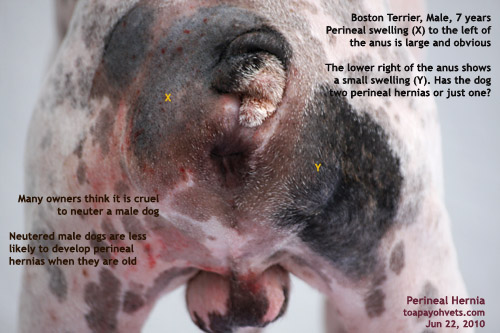
502. Perineal hernia in a Boston Terrier one year ago

The Boston Terrier was operated one year ago. I review this case which was operated successfully (no anaesthetic deaths or complaint of recurrence) before I operate on the “mother of all perineal hernias” of the Silkie Terrier (described below) who is 10 years old and in a more risky anaesthetic position.


The pictures and more details of this record are at:
http://www.bekindtopets.com/animals/20100625constipation_perineal_hernia_old_Boston_Terrier_male_singapore_ToaPayohVets.htm


CASE 1
This Boston Terrier case was written: 25 June, 2010
Boston Terrier, Male, Not neutered, 7 years, 12.4kg
Big swellings besides the anus, the left swelling being bigger.
Difficulty in pooping for past 3 weeks.


A knowledgeable young man who has his own views of dog care.
He presented a Boston Terrier with constipation for the past 3 weeks. He went to Vet 1 who referred him to another vet after taking a blood test as she did not want to perform the surgery. She had given him a laxative for the dog and the dog had passed loose stools instead of hard ones.


“Why don’t you see the referred vet?” I asked.


“The Surgery has a bad reputation,” the young man had googled the name of the practice he was referred to by Vet 1. “There is a very bad complaint about the vets from one dog owner. So I better not go there.”


“All veterinary practices will have one or two nasty complaints about service,” I educated this young man. “The busier the practice, the higher the chances of getting complaints. This is because the vet has no time to handle each case as thoroughly as he or she would love to. This applies to over-worked doctors in human medicine too especially in the emergency wards.”


VACCINATION HISTORY MUST BE ASKED
“Has your dog been vaccinated?” I asked.
“No vaccination for the past few years. Do you have parvovirus in your Surgery?” the young man asked me.


“Fortunately for your dog, my practice does not have parvo-viral cases for many months as I seldom provide service to the dog breeders nowadays. You have taken a big risk exposing your dog the risk of parvoviral and canine distemper infections.”


PRE-OP BLOOD TEST IMPORTANT FOR OLD DOGS BEFORE SURGERY
I checked Vet 1′s blood test results. It is wise not to trust the blood results of other practices based on one of my experiences (see one case I had written). However, he had paid $ 130 for the test and I would not insist as that would increase his vet bills. Overall, the dog was examined and was healthy. So I took the chance.


ANAESTHESIA
IV saline given. Then I gave Atropine 0.4 ml IV followed by Domitor 0.2 ml IV
Waited 10 minutes. Isoflurane gas mask. Dog struggled. So, I gave Zoletil 100 @ 0.1 ml IV. This sedated the dog who was masked and given isoflurane gas at 5%. The dog slept and was intubated. Isoflurane at 1-2% maintenance was done by my experienced assistant, Mr Saw. I asked him to increase the dose when the pelvic fat kept coming out from the hernia after pushing the fat into the abdominal cavity. The dog recovered smoothly.


SURGERY
I gave him antibiotics to take and schedule perineal hernia surgery 2 days later. The surgery took nearly an hour as the hernia was large. The hernia bulge with pelvic fat is large, around 4 cm x 6 cm. An electro-incision made a big cut to the left of the anus.


It was difficult to identify the medial coccygeal and levator ani muscles in this case as there is a lot of inflammation. The internal pudendal artery and vein and the pudendal nerve on the dorsal surface of the internal obturator muscle looked compressed as I showed to my assistant Mr Saw who nodded his head. Judging from his eyes, he did not believe they were what I said.


Is there a right perineal hernia too?


Electro-incision. Big amount of pelvic fat. A retractor enabled me to have a good field of view to stitch up the defect


See the big hole through which part of the colon and pelvic fat herniated through causing a big backside swelling


Left perineal hernia repaired. Neutering in 3-4 weeks if the owner wants to do it. The right perineal hernia may need to be repaired later.
The internal obturator muscle is on the ventral aspect of the pelvic diaphragm. This was a big fatty mass horizontally covering the muscle, unlike the no-fat muscles illustrated in Small Animal Surgery, T.W. Fossum 1997, pg 354.


I used a retractor to spread open up the operating area and to see the pudendal vessels and nerve just above the obturator muscles in this case. Do not stitch these vessels or nerves.


POST-OP
Dog woke up fast. Given tolfedine painkillers.


TWO HERNIAS TO BE OPERATED AT ONE GO
I doubt that it is possible to do two hernias at one go as the muscle stitching on one side (i.e. left hernia in this case) pulled the left anal area tightly to cover the herniated hole. Therefore doing two hernia repair at the same time just is not in the interest of the dog as he will feel very uncomfortable and painful.


LOOSE STOOLS leaking out from the anus. This must be plugged. The dog had been given an oil laxative by Vet 1 for 3 days and the loose stools start to come out despite atropine injection.


CONCLUSION
The dog was OK and was warded for at least 4 days as the owner did not have a crate to prevent the dog running loose. I checked the dog every day to ensure that he had proper nursing care and pain-killers. The boy’s parents came to visit the dog yesterday. The dog should be back home after 7 days. He had managed to rub his backside onto the floor of the crate despite tolfedine 60 mg at half a tablet per day for 3 days. I decided to give him 1/4 dose of a 30mg phenobarb and then Rimadryl for another 3 days to prevent pain and inflammation.


P.S
1. Yearly vaccination is important. Fortunately this dog did not get infected with parvoviral disease in the practice of Vet 1 which is a very busy practice and in my surgery. Otherwise, I end up with a dog passing blood in the stools and dying later. At the time of writing this report, it is still early at Day 5 after visiting Vet 1. Parvoviral signs come in around 10-14 days after infection.


2. “Neutering the dog when he was younger would have decreased the chances of him getting perineal hernia,” I said. “Perineal hernia is more common in non-neutered dogs.” The young man said: “It is cruel and that is why I don’t do it.” He has been advised to neuter the dog around 2-4 weeks later. As for the right perineal hernia, it is a smaller one. Wait and see. If the dog is neutered and there is
no more swelling in the backside, then there is no need to do a right perineal hernia repair.


3. High anaesthetic risks. I don’t enjoy doing high anaesthetic risk surgeries as they are very stressful for me. If the dog survives, everybody is pleased. There will be deaths and the owners may be very emotional and angry. Some may post a nasty complaint in the internet. To minimise risks of deaths of old dogs on the operating table, I don’t force myself to perform hernia repair and neutering at the same time. The owner has to appreciate that I don’t take risks unnecessary.
UPDATE AS AT JULY 11, 2011
No news from the owner since the surgery in Jun 2010. I presume all are OK as now news is good news.


CASE 2
ANOTHER MORE CHALLENGING CASE ONE YEAR LATER
THE MALE DOG HAD A VERY LARGE BACKSIDE SWELLING – PART 1
Dr Sing Kong Yuen, BVMS (Glasgow), MRCVS
Case: Updated: 14 July, 2011


This Silkie Terrier case was written: 24 June 2011
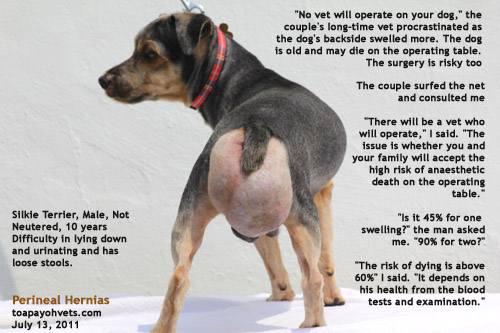
Silkie Terrier, Male, Not neutered, 1- years, 6.5kg
Big swellings besides the anus, the left swelling being bigger.
Difficulty in pooping for past 3 weeks.
I have not seen perineal hernias since I operated on the above-mentioned Boston Terrier one year ago. Surprisingly, on Sunday, July 10, 2011, my assistant Mr Min said that a couple insisted on seeing me. Normally, all cases go to Dr Vanessa Lin but I was around at the reception to get a pulse of the grass-roots from 9 am to 6 pm and to ensure that the waiting times are kept to the minimum. Only at the receptionist’s counter can I know what is the situation of the waiting time like, rather than depend on the receptionist to enlighten me.


The couple said to me: “My vet said that no vets in Singapore would operate on my 10-year-old Silkie Terrier. He had said that the dog is old and to leave the swelling alone. But it kept growing bigger!”


He was not neutered and had a backside lump 3/4 the size of the biggest mango you can see in Singapore. The dog had difficulty in pooping and the older parents were concerned about his quality of life. The dog could eat, drink, poop and pee without difficulty and was active.


“There will be vets in Singapore that will operate on this dog,” I said when the couple brought the dog in later for examination. “The main issue is that the operation will take a long time and the dog may just die on the operating table. No vets want to do a dog that dies on the operating table.”
I had asked them to illustrate as they did not bring the dog down at first. A male dog, not neutered, big swelling from below the anus (in this case) instead of to the sides of the anus as in unilateral perineal hernias. The couple had actually diagnosed perineal hernias via the internet education and so they knew what was wrong with their dog. The problem was that their vet did not want to operate and put his reputation on the line when the dog dies on the operating table. What should I do?


This was the “mother” of all perineal hernias. Both left and right perineal hernias have “amalgamated” to form a large 3/4-Taiwanese mango-sized lump to the right, left and below the anus. Taiwanese mangoes are gigantic but are not sweet and they measure around 25 cm x 10 cm x 7 cm. So, you can imagine that the swelling was really gigantic.


The surgery will take over 1.5 hours and the old dog’s heart may just stop beating. The dog needs to be operated as he has had been licking his skin thin. Continuous licking to relieve his pain and irritation as the intestines and omental fat prolapse through the pelvic muscular defect from both the left and right side. It was hard for him just to sit down too.


http://www.kongyuensing.com/pic/20110713perineal-hernias-bilateral-silkie-terrier-male-10-years-toapayohvets-singapore.jpg


“Do your parents know that they may not see the dog alive once he gets operated?” I asked. The aged parents are the care-givers. The couple said: “My parents say it is better to take the risk rather than let the dog suffer with such a big dangling mass. The groomer had nicked the lump earlier and discovered this hernia. Otherwise, we would not know it exists!”


The dog was in good body condition. I checked his heart. His heart was surprisingly normal. He was alive and active now. As if he has not a worry in this world while his caregivers bear the burden and surgical risks on their shoulders. Should I pass the buck? And to whom? To my two associate vets? This is the type of challenging cases that I prefer not to take on and it will be most unkind to pass the buck to my two associate vets as there is the possibility of post-surgical complications like infections, bleeding and nerve damages in addition to death on the operating table. So, I did not refer the case to them. It is a moderately difficult surgery but it will take a long time to do. The longer the time of anaesthesia and surgery, the likely that the old dog’s heart will just stop and the dog dies on the operating table!


If the surgery can be completed in 15 minutes, the old dog is very likely to survive the anaesthesia. Unfortunately, this surgery will take a long time as both hernias seem to be required to be operated on at the same time since the intestines and omental fat have leaked and spread to each other’s sides! That is why I say that this case is the “mother” of all perineal hernias.


The dog was operated on July 13, 2011. The whole process started from 9 am and ended at 12 noon. The surgery itself started from 9.30 am to 12 noon. It was the type of surgery that most vets would prefer not to be challenged to do as there were 3 hernias. The main one was the left perineal hernia with defect from above the anal area to the ventral most part of the backside. This would be at least 6 inches long, 3 inches wide and 5 inches deep. (1 inch = 2.5 cm). The right perineal hernia was two smaller holes separated by a band of muscle.


In the left perineal hernia, the bladder and large intestines had prolapsed. Over time, the intestines have had shifted from the left half of the backside to the right half. The dog licked the swollen area (mango-sized) over the months and the skin had become very thin and about to rupture. You can see the intestinal coils more prominent on the right side. So, I thought this was a right perineal hernia. Actually, it was a left!


Details of the surgery and anaesthesia done on June 13, 2011 will be recorded in Part 2 at:


www.sinpets.com/F5/20110714perineal_hernia_old_Silkie_Terrier_male
_dysuria_painful_backside_singapore_ToaPayohVets.htm


Wednesday, September 18, 2013

Bull Terrier dogs


The Bull Terrier is also known as: English Bull Terrier

Fast FactsGroup classification: Terrier    Country of origin: England    Date of origin: 19th century
Weight (M): 60 – 70 lb    Height (M): 21 – 22″    Life expectancy: 11 – 14 years
Weight (F): 50 – 60 lb    Height (F): 21 – 22″


General Description of the Bull Terrier

 Strong and handsome, the Bull Terrier is a dog of muscular symmetry and sweet disposition. The head is long and deep, curving from nose to the top of the skull; when viewed from the front, the head should resemble an oval. Eyes are close and deep set, small and triangular. Ears are small, erect and close set; teeth meet in a scissors bite. The body is muscular and big boned, though never coarse. The tail is short and carried horizontally. Feet are round, compact and catlike. The Bull Terrier’s coat is short, glossy and harsh to the hand, and the skin should be tight throughout. Color is either solid white with our without markings on the head, or any color other than white (often brindle) with white markings on the head.


Bull Terrier Temperament

 The Bull Terrier is a friendly and gentlemanly dog of inquisitive and imaginative temperament. It is always up for a game or a joke, and enjoys being around people. The Bull Terrier is a notoriously stubborn and assertive breed, and as such it may be a bit much to handle for a first time owner. Those with limited dog experience are encouraged to think twice before adopting this dog, since proper obedience training may be difficult. The Bull Terrier is aloof toward other dogs and, consistent with its terrier heritage, enjoys giving chase to small animals; occasionally, a poorly socialized or abused Bull Terrier may behave aggressively toward other dogs. Bull Terriers are usually pretty friendly toward strangers and other pets, especially when raised with them from a young age.


Caring for a Bull Terrier

 Taking your Bull Terrier for a long walk or romp in the park every day will prevent hyperactive behavior and promote good health and long life in the dog. Take care that your dog is stimulated both physically and mentally, or you may come home to find your favorite pair of shoes in tatters. The Bull Terrier can adapt to outdoor living in temperate climates, though it prefers living inside. Coat care is easy, and entails little more than an occasional brushing to remove dead hairs. Some white Bull Terriers carry the Dalmatian’s deafness gene. Other health issues in the breed include hereditary neprhitis, cystic kidney disease, renal dysplasia, SAS, mitral stenosis, dilated cardiomyopathy and allergies.


Other:

Description: A replica of the Bull Terrier, the Miniature Bull Terrier shares the same breed standards except for the height. They are strongly built, symmetrical and active, with a keen, determined and intelligent expression. They have thick muscular bodies, despite their small stature. Miniature Bull Terriers are full of fire, having a courageous, even temperament. Mini Bulls are comical, lively, playful and mischievous dogs who may be small, but are not a lap dog. This breed has the distinctive mark of a muzzle without a stop. It has the typical Romanesque face. Mini Bull Terriers are active and tenacious. They can be fearless, but reserved when it comes to other dogs instigating a fight. Bull Terriers have been known to avoid fights when they are not the one picking it. They are not guard dogs, but they are scrappy fighters. They love to be with their family, and are a polite breed. The Miniature Bull Terrier has all of the spunk and tenacity of the larger Bull Terrier, just in a smaller package.

Other Names: English Bull Terrier, Miniature English Bull Terrier, Mini Bullies, Mini Bulls


Type: Terrier


Height: 10 – 14 inches.
Weight: 24 – 33 lbs.


Colors: White, white with another color or completely colored. They can be any dog color, including brindle, red, black, fawn or even tricolor. Blue and liver colors are undesirable in the show ring.
Coat: Short, dense, and flat, with a fine gloss.


Temperament: Miniature Bull Terriers are fearless and determined. They love to be companions, and thrive off of family. They are stubborn, courageous, playful and energetic. Mini Bullies are clownish, humorous and fun loving. They can be protective and willful, and do not obey orders consistently. They are difficult to train, and males usually do not get along with other males, although any other combination is fine. They love to play in family rough-housing and enjoy the company of their owners, and should not be left alone for hours.
With Children: Yes, generally good with children, but children should be warned not to tease them.
With Pets: Accepts most other pets, but needs to be socialized to cats. Males are aggressive with other males, but this breed will get along if the combination is male/female or female/female, as long as it is not male/male.
Special Skills: Family pet.


Watch-dog: Very High. Miniature Bull Terriers are very alert and protective.
Guard-dog: Medium. Although protective and sometimes possessive, they are not the biggest defensive dog.


Care and Exercise: Grooming is easy, minimal grooming is necessary for Miniature Bull Terriers. Brush with a firm bristle brush, bathe or dry shampoo when necessary. Bull Terriers need plenty of exercise, and should be kept on a leash.
 Training: Training should begin early as they require firm and precise, but not overbearing handling.
Learning Rate: Low. Obedience – Low. Problem Solving – Low. This breed is mostly brawn.


Activity: High.
Special Needs: Attention, socialization, supervision around water and training.
Living Environment: Apartment living is fine as long as sufficient exercise is given to the Miniature Bull Terrier. Owners must desire an aggressive, active breed.


Health Issues: Zinc deficiency and deafness.


Life Span: 12 -13 years.
 Litter Size: 1 – 9 puppies. Average is 5 puppies.


Country of Origin: Great Britain
History: The Miniature Bull Terrier is a direct descendant from the Bull Terrier and they share the same history. Bull Terriers were crossed with the old English Bulldog and English White Terrier (now extinct) in the early 19th century. James Hinks, from Birmingham in Great Britain, originally developed the breed between the 1830s and the 1860s. They are also most certainly mixed with Dalmatian, and are thought to have converged with the Spanish Pointer, Greyhounds and Whippets. White being Hinks’ favorite color for the breed, the dogs were originally all white. The characteristics chosen from this mixing of the breeds was the egg shape of the head, the white color, and the small triangular eyes. Along with these preferred attributes came frequent deafness, heart disease and skin problems. At this time they were a lighter more agile dog who was used to bait bulls, dog fighting and to tackle vermin. Color was only added later on in the 1900s when crosses were made with the Staffordshire Bull Terrier. Added as an AKC variety of Bull Terrier, the coloreds were not originally well-received, but soon found their place. The white Bullies were nicknamed the “white Cavalier” because of their ability to discern pit fighting from confrontations outside of work. Some Bull Terriers were known to avoid a fight when they weren’t in the pit, and were bred for the ability of not provoking a fight. Bull Terriers were prized for their courage, agility and tenacity. They were rated as the third most suitable breed in wartime achievements by Colonel James Y. Baldwin, Commander of the War Dogs Training Establishment. Originally, the ears had to be cropped, but since 1895 when cropping was outlawed in Britain the breed has since been fixed to have naturally cropped ears. At one time the smallest white bull terriers were called Coverwood Terriers. Sometime during the 1900s the Miniature Bull Terrier was bred from the smallest of Bull Terriers. At first, the distinction was set on the weight of the breed, this sometimes being no different between the two. This caused a number of Mini Bulls to be bred down so small they looked like Chihuahuas. Because of this, in the 1970s, the breeds’ distinctions were set at height, making a Mini Bull to be under fourteen inches, and normally are no less than ten inches. Sometimes a defender and sometimes a clown, this uniquely shaped breed has since become a popular sight among Americans.